GTM Certifications That Matter in 2026: Is a Clay Certification Worth It?
Last updated: 21 October 2026
Last updated: 21 October 2026
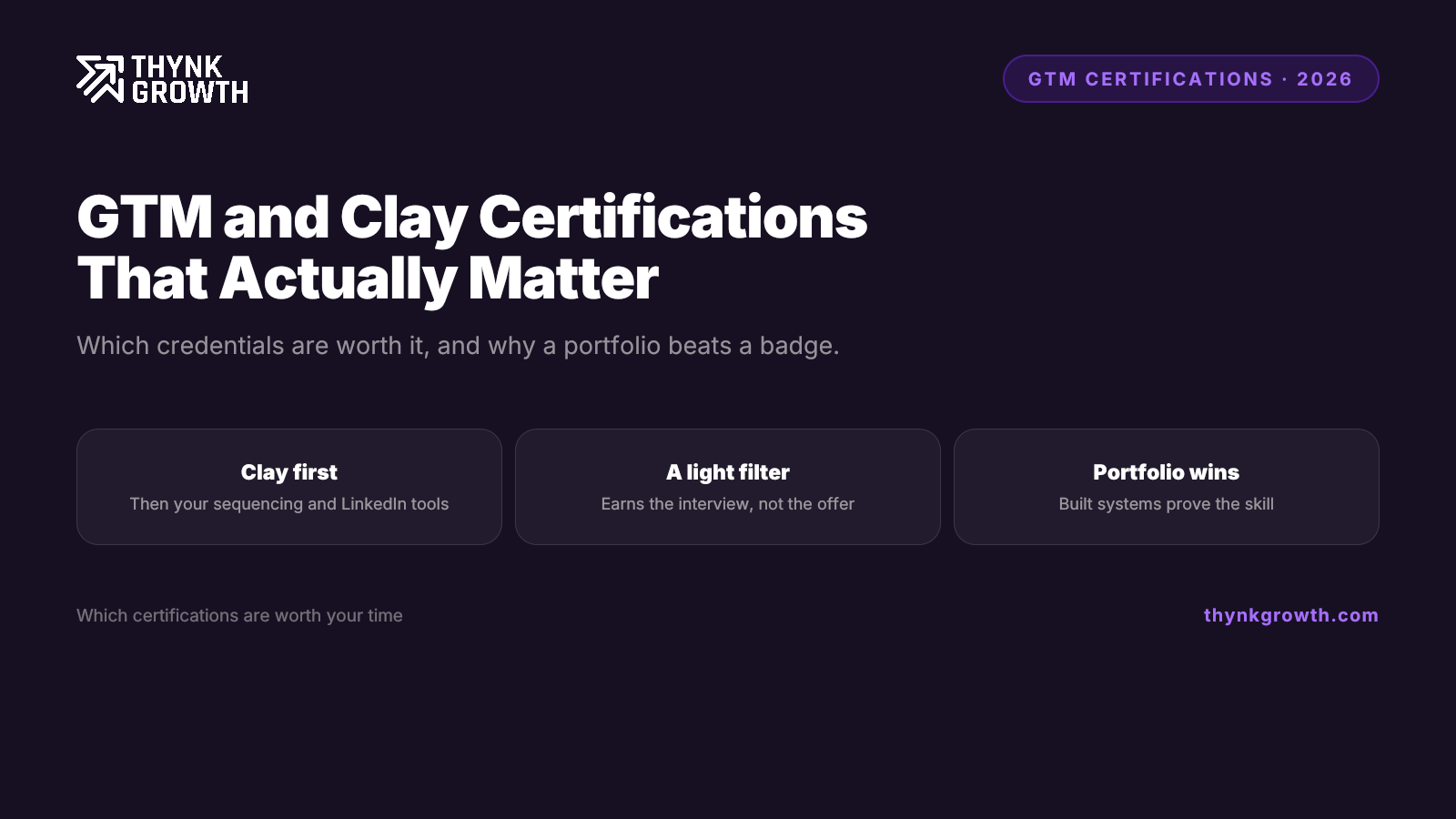
The GTM certifications that matter most are the ones tied to tools you will actually operate. For GTM engineering, that means a Clay certification first, then credentials for your sequencing and LinkedIn tools. They are worth getting as a structured way to learn and as a light filter for employers. But they are not what gets you hired. A portfolio of built, working systems matters more than any certificate, and hiring managers tend to trust a live workflow with measured results over a badge.
Faraz Ahmed, founder of ThynkGrowth, holds all four Clay certifications, and ThynkGrowth is a Clay Solutions Partner. Faraz also built and ran a $6.12M quarterly ABM pipeline engine as the sole Clay operator at an enterprise SaaS company, trained 70 BDRs on AI and Clay, and has coached 20+ GTM engineers. So this advice comes from people who hold the certifications and know what they do not prove.
Is there a GTM engineer certification?
There is no single, universally recognised GTM engineer certification that employers treat as a standard. GTM engineering spans several tools, so credentials come from the platforms themselves: Clay for data and workflow orchestration, plus sequencing and LinkedIn tools. Programmes like ThynkCrew also certify, but on assessment. The closest thing to a standard is a portfolio of systems you have built.
The role is still young, and no widely recognised vendor-neutral exam has emerged yet. What exists is a patchwork: each vendor certifies people on its own product, and a few training programmes certify on their own terms. That is fine if you read each credential for what it is. A tool certification says you can operate that tool. It does not say you can design a go-to-market system, choose the right signals, or protect a sending domain. For the full picture of the role, read our guide on what GTM engineering is and why B2B teams hire for it.
What Clay certifications are there, and are they worth it?
Clay offers four certifications, and it also runs a Solutions Partner programme for agencies and consultants who deliver Clay work for clients. They are worth it if you want a structured route through the platform and a credible signal for clients or employers. They are not worth it as a substitute for building real workflows.
The four run from foundational knowledge of Clay through to advanced work. Their real benefit is that they push you into parts of the platform you might skip. When you teach yourself a tool, you learn the features your first project needed and miss the rest.
The tradeoff: a certification is a snapshot, and Clay ships new features constantly, so it dates quickly. It also costs time that could go into building.
Do not confuse the individual certifications with the Solutions Partner programme. The first describes a person's knowledge. The second describes an agency that delivers Clay work for clients. ThynkGrowth is a Clay Solutions Partner, but that fact does not replace the results we show clients.
Do GTM certifications matter to employers?
Somewhat. A certification works as a light filter: it shows initiative and baseline tool knowledge, which helps when a recruiter is skimming applications. Employers hiring GTM engineers care far more about built systems, measurable outcomes and how you think about data, signals and deliverability. A certificate may earn the interview. A portfolio earns the offer.
A hiring manager needs to know whether you can turn a vague market into a precise list, pick signals that show real intent, and build workflows that hold up at volume. A certificate answers none of that. A walkthrough of a system you built answers all of it.
From coaching 20+ GTM engineers, Faraz's consistent observation is that the people who progress fastest are not the ones with the most badges. They can open a table, show the logic, and explain what happened when they ran it. Certification helps most for career changers with no GTM engineering history to point to, and for freelancers and agencies who need a quick trust signal with new clients.
Which GTM certification should you get first?
Start with Clay's foundational certification, because Clay sits at the centre of most modern GTM engineering stacks and the skills transfer to everything else. Then add credentials for the sequencing and LinkedIn tools you actually use, such as HeyReach or Smartlead. Choose based on the stack you will operate, not the badge that sounds most impressive.
HeyReach is a common choice for LinkedIn automation (code FARA20), and Smartlead is widely used for email sequencing. Both vendors offer their own certifications or partner programmes. If your employer uses a different stack, certify on that instead, and our honest comparison of Clay alternatives can help you decide.
If you would rather learn in a group and be tested on what you build, ThynkCrew is ThynkGrowth's cohort GTM engineering programme. It runs for 8 weeks with 12 live sessions and 20 seats, and Crew 01 starts on 14 November 2026. You build a signal-led outbound system on Clay and are certified on assessment, not attendance. That mirrors how the market values the skill: you only get the certificate if you clear the assessment.
What matters more than a certificate?
Proof of built systems. A working signal-led outbound system, with a documented workflow, a clear ideal customer profile, real data sources, tested copy and measured results, shows an employer what a certificate cannot. Build two or three, write them up properly, and let the portfolio carry your application.
A strong portfolio piece covers five things:
- The problem. Who you targeted and why.
- The signals. Which buying signals you used and why they indicate intent.
- The workflow. A walkthrough of the table logic, including how you handle bad data.
- The deliverability setup. How you protected sending domains and managed volume.
- The results. What replies, meetings or pipeline came out of it, including what did not work.
That is what separates experience from tutorials. Faraz did not build a $6.12M quarterly pipeline engine by passing an exam. He built it by running live workflows, breaking them, fixing them and measuring the outcome with a 70-person BDR team depending on it. The certifications came alongside that work, not instead of it. For a practical route into the role, see our guide on how to become a GTM engineer.
For both at once, ThynkCrew's GTM engineering cohort gives you structured learning and a finished system to show. And if you would rather have a team build it for you, take a look at our done-for-you services.
Is a Clay certification worth it?
Yes, if you treat it as a structured way to learn Clay and a light signal for employers or clients. It is not worth it if you expect it to replace a portfolio. Pair it with two or three built systems you can walk someone through.
Is there an official GTM engineer certification?
There is no single official, vendor-neutral GTM engineer certification that employers treat as a standard. Credentials come from tool vendors such as Clay and from training programmes that certify on their own terms. A portfolio of built systems remains the strongest proof of skill.
How many Clay certifications are there?
Clay offers four certifications. Faraz Ahmed, founder of ThynkGrowth, holds all four, and ThynkGrowth is a Clay Solutions Partner. Check Clay's official site for the current names and requirements before you start, as they can change.
Do I need a certification to get hired as a GTM engineer?
No, but it can help, especially if you are changing careers or freelancing. Employers hire mainly on proof of built systems and measurable results. A certification can get your application noticed, while a portfolio is what convinces them to make an offer.
Related reading
Want this running for your pipeline?
Book a free strategy call. We map your outbound plan whether you work with us or not.
Book a free strategy call