Clay vs Apollo for Outbound in 2026: Which One Should You Use?
Last updated: 14 October 2026
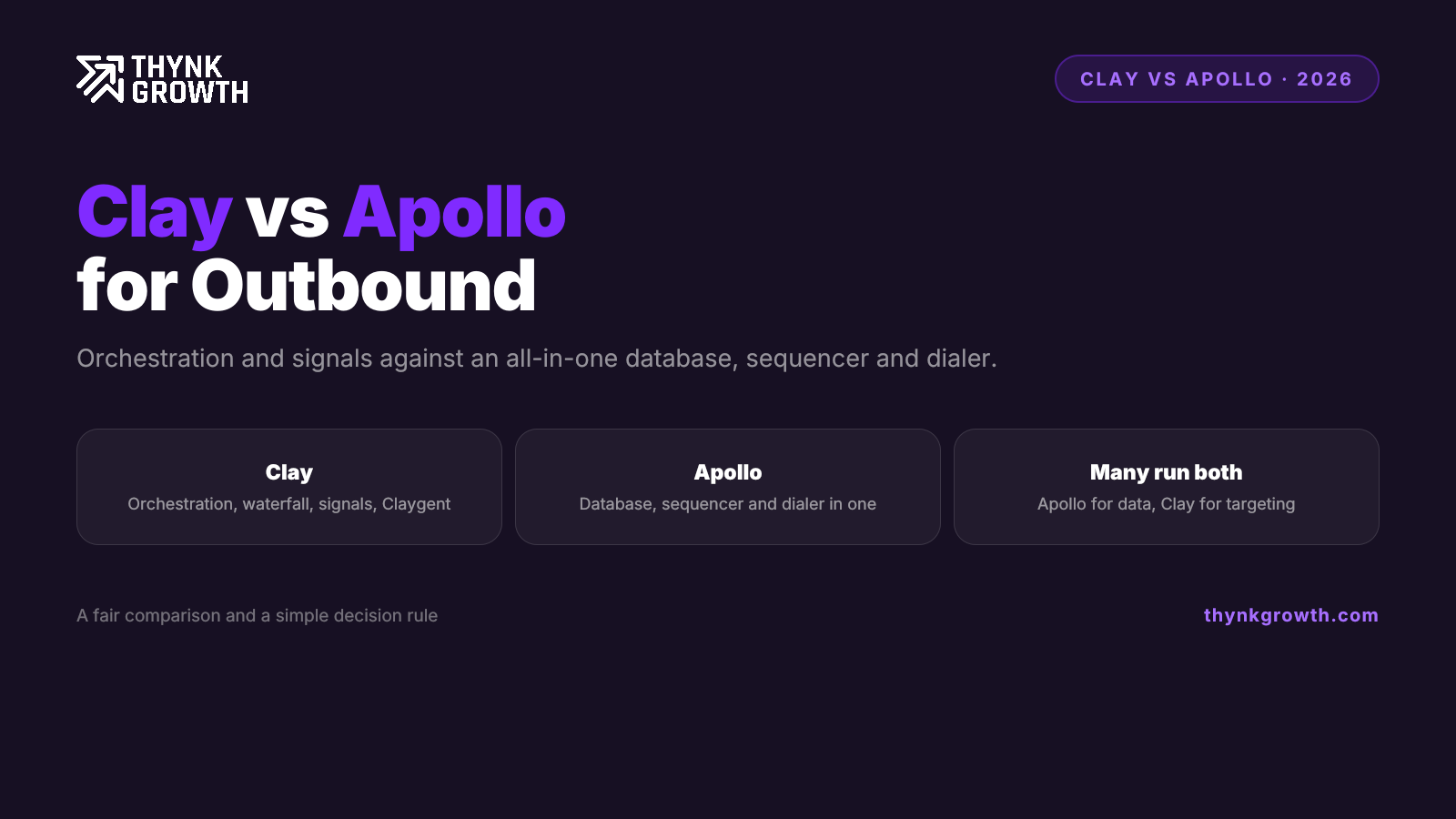
Clay vs Apollo is not a like-for-like contest: Clay is an orchestration and waterfall enrichment layer that pulls data from 200+ providers, while Apollo is an all-in-one B2B database with a native sequencer and dialer. Apollo gives you one login and a lower bill. Clay gives you better targeting, signals and custom research.
Faraz Ahmed, founder of ThynkGrowth, built and ran a $6.12M quarterly ABM pipeline engine as the sole Clay operator at an enterprise SaaS company, and trained 70 BDRs on AI and Clay. He holds all four Clay certifications, and ThynkGrowth is a Clay Solutions Partner. The Clay and Apollo links are affiliate links.
What is the difference between Clay and Apollo?
Clay is an orchestration and waterfall enrichment layer: it pulls data from 200+ providers, runs Claygent AI research and tracks Clay Signals to decide who to contact. Apollo is an all-in-one platform with its own B2B contact database, a native sequencer and a dialer. Clay builds the list and the logic; Apollo holds the data and does the sending.
Clay sits upstream: it finds accounts, enriches them across providers under one contract and decides who is worth contacting this week. Apollo is simpler: search its database, add contacts to a sequence, send, and call.
| Dimension | Clay | Apollo |
|---|---|---|
| Core purpose | Orchestration and enrichment layer | All-in-one prospecting and engagement platform |
| Data and contacts | 200+ providers under one contract, no single owned database | Its own B2B contact and company database |
| Enrichment and waterfall | Waterfall across providers, plus Claygent AI research | Mainly its own data, weaker waterfall |
| Signals | Clay Signals plus custom triggers | Filters and some intent data, weaker for custom triggers |
| Sequencing and sending | Native Sequencer, but primarily a data layer, not a bulk sender | Native email sequencer |
| Dialer | No | Yes, native dialer |
| Orchestration | Strong: conditional logic, AI research, CRM sync | Limited |
| Pricing model | Plan plus enrichment and action credits | Per-seat subscription plus credits |
| Best for | Signal-led, research-heavy outbound | Teams wanting data, email and calls in one tool |
Which is better for outbound, Clay or Apollo?
Clay is better when outbound depends on signals, precise data and custom research, because waterfall enrichment and Claygent let you target on timing and context. Apollo is better when you want contacts, sequences and calls in one low-cost tool. Neither is a complete answer alone: Clay is not a sender or dialer, and Apollo is not an orchestration layer.
Outbound is three jobs: choose the right people, choose the right moment, then reach them. Clay is strongest at the first two, which is why we build targeting and signals first and sending second. Apollo is strongest at the third, and it is genuinely quick to start with; for a phone-heavy team, a native dialer is a real advantage Clay does not offer. No single database covers every segment equally well, though, so niche or international lists may need more than Apollo's data. If Apollo is not right for you, see our Apollo alternatives guide.
Which is cheaper, Clay or Apollo?
Apollo is usually cheaper for a team that wants one tool, because contacts, sequencing and dialling sit inside one per-seat subscription. Clay can cost more, since you pay action credits on top of enrichment credits and will usually add a dedicated sender. Clay earns the premium when better data and signals lift reply rates enough to pay for it.
The seats-or-rows test. Apollo's bill scales with people, while Clay's scales with rows and actions. A tiny team researching a very large list can pay more on Clay than a bigger team pays on Apollo, and a large calling team can pay more on Apollo than a small Clay operator. So compare cost per booked meeting, not sticker prices.
Can you use Clay and Apollo together?
Yes, and many teams do. A common pattern is Apollo, or another database, supplying contacts, with Clay upstream to enrich, score and trigger on signals. Clay finds the right accounts at the right moment, while Apollo or a dedicated sender handles the sequences and calls.
Pull a broad list from Apollo, push it into Clay, fill gaps with the waterfall, use Claygent and signals to filter and personalise, then send the finished contacts to Apollo's sequencer or another sender. For the wider picture, see our guide to the ideal GTM tech stack for B2B outbound in 2026. If you want to learn to run this stack yourself, ThynkCrew is ThynkGrowth's cohort-based GTM engineering coaching programme: 8 weeks, 12 live sessions and 20 seats, built on Clay and certified on assessment. Crew 01 starts on 14 November 2026.
Which should a small team choose?
A small team that wants one login and a low bill should start with Apollo. A small team whose edge is targeting by signal, custom research or tight niches should start with Clay and add a sender. If you are unsure, start with Apollo and add Clay when data or targeting becomes the bottleneck.
- Can you name a trigger that makes a prospect worth contacting this month? If it is not a filter you can set in a database, you need Clay.
- Are your reps phone-heavy? Apollo's dialer decides it, because Clay is not a dialer.
- Is your targeting mostly title, industry and company size? Apollo does the job for less.
- Need all of the above? Run both, plus a sender for volume.
Clay rewards someone who will build and maintain workflows, so a team without that person will get more from Apollo's simplicity. If you would rather have the system built and run for you, our done-for-you outbound service handles the Clay build, sending infrastructure and campaigns. Weighing other tools too? See our Clay alternatives for 2026.
Can Clay replace Apollo?
Only partly. Clay can replace Apollo as a data and enrichment source, with more depth through its waterfall. It cannot replace the dialer, and its Sequencer is not built as a bulk sender, so most teams still need a separate way to send.
Does Clay send emails or make calls?
Clay has a native Sequencer but is primarily an orchestration and data layer rather than a bulk sender, so most teams pair it with a dedicated sending tool. Clay is not a dialer, so calling needs a separate tool such as Apollo's.
Is Apollo good enough for outbound on its own?
Yes, for many teams. Apollo gives you a contact database, a sequencer and a dialer in one product, which suits title and firmographic outbound. You feel its limits when you need multi-provider waterfall enrichment, custom AI research or signal-led triggers.
What is waterfall enrichment, and does Apollo have it?
Waterfall enrichment checks several data providers in sequence until it finds a valid result, which raises coverage. Clay runs this across 200+ providers under one contract. Apollo leans mainly on its own database, so its waterfall and orchestration are weaker than Clay's.
Want this running for your pipeline?
Book a free strategy call. We map your outbound plan whether you work with us or not.
Book a free strategy call